Development of an Automated Control System for the Water Demineralization Unit — Samarkand Chemical Plant




Development of an Automated Control System for the Water Demineralization Unit — Samarkand Chemical Plant
Automation of Multi-Stage Water Treatment: Development of a Software and Hardware Complex for a Chemical Plant in Uzbekistan
Uzbekistan
Branch:
Chemical industry
Year:
2026
About the project:
For the Samarkand Chemical Plant, it was required to develop a software and hardware complex (SHC) for automatic control of a multi-stage water treatment unit designed to produce demineralized and deeply desalted water.
The unit combines several interrelated process operations: mechanical filtration, ultrafiltration, reverse osmosis, sorption treatment, mixed-bed filtration, regeneration, and heat exchange.
The main task for Aprotec Engineering was to develop automatic control algorithms ensuring coordinated operation of the process units, monitoring of process parameters, control of duty and standby modules, and execution of automatic process operations.
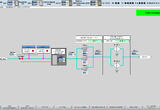
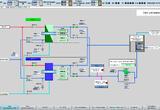
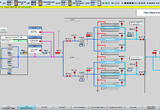
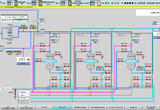
Within the project, the SHC covers six main units of the installation:
— raw water and self-cleaning filters unit;
— ultrafiltration unit;
— reverse osmosis unit;
— heat exchange and carbon sorption filters unit;
— mixed-bed filters unit (MB);
— regeneration unit.
The developed SHC provides automatic control of the process units of the installation, as well as manual control from the operator workstation (OWS) and commissioning control from the control cabinet.
The implemented functions include:
— automatic control of process units and modules;
— manual equipment control from the operator workstation;
— commissioning control mode from the cabinet;
— monitoring of alarm signals and process states;
— selection of duty and standby modules;
— control of pumps, valves, and reagent dosing;
— monitoring of flow rate, pressure, temperature, conductivity, and pH of water.
The control logic provides for the operator to select duty and standby modules depending on the required configuration of the installation:
— ultrafiltration and reverse osmosis — one duty and one standby module (1+1) or two duty modules;
— sorption filters — three duty and one standby module (3+1);
— mixed-bed filters — two duty and one standby module (2+1).
The SHC implements algorithms for automatic execution of process operations:
— automatic BWS and CEB washings;
— automatic transfer of the reverse osmosis unit to CIP cleaning when permeate quality degrades by 10% or when the pressure drop across the membrane increases by more than 15% — according to the specified automation criteria;
— return of off-spec permeate to the ultrafiltrate tank when it does not meet the specified conductivity requirements.
Separate algorithms have been developed for controlling thermal processes and protecting equipment.
Heat recovery is organized using the HE-J1-1 heat exchanger: condensate is used to heat the raw and demineralized water. The process flow includes heating stages up to 75 °C and subsequent heating up to 90 °C before water is supplied to the customer.
pH correction algorithms are also provided: ammoniation after the mixed-bed filters and dosing of acid or alkali at the corresponding process stages.
As a result of the project, a software and hardware complex for automatic control of the water demineralization unit of the Samarkand Chemical Plant was developed.
The SHC covers six process units and provides control of the successive stages of water treatment — from preliminary filtration to production of deeply desalted water.
The process flow of the installation includes raw water pretreatment, ultrafiltration, reverse osmosis, mixing of permeate with condensate, mixed-bed filtration, chemical parameter correction, and heat exchange before water is supplied to the customer.
The detailed process flow is presented in the installation diagram.

The project demonstrates Aprotec Engineering's experience in developing control algorithms for multi-stage process units, where it is necessary to coordinate the operation of various modules, automate washing and regeneration, monitor water quality, and ensure equipment protection in various operating modes.


Our other projects


